
|
Americans
United P.O. Box 270, Winchester, MA 01890 |
|
.
AU Home
Press
Releses
Church
& State Mag
About
AU
Resources
Legislative
Work
Churches
& Politics
Public Schools
Reproductive
Rights
Religious Outreach
AU
Chapters
Ways
To Support AU
The Right to an Abortion is a Religious Freedom Issue
Some Christians seem to have fixated on the passage in the bible that says "God knows you in the womb" and have been trying to push their belief on others through state and federal courts such as the Ala. Supreme Court decision on IVF and the US Supreme Court dismanteling of Roe vs Wade. This violates First Amendment religious freedom since there are Christians and other religions that believe the soul does not enter the body until later, or even not until the first breath is taken (see HERE & HERE). HERE
Supreme Court Justice Amy Coney Barrett is a threat to the separation of church & state and religious freedom.
Americans United lawsuit in 2018 to stop the town of Acton, Mass. from spending taxpayer funds to support two local churches was decided by the Supreme Judicial Court
The court handed down a split decision, ruling that public money can indeed be used to support religious activities, but under strict guidelines and with rigid scrutiny. More details are available HERE
Towns Should Not Use Public Funds to Support Churches,
Americans United Says In LawsuitHistoric Status Of Buildings Is Not An Excuse To Subsidize Religion With Taxpayer Funds, Group Says
The Massachusetts Chapter of Americans United for Separation of Church and State was first contacted by a member on the issue described below. After gathering information we sent the information to the AU Legal Department. The AU-MA Chapter also worked to recruit some of the plaintiffs and supplied the name of the attorney from Massachusetts, Russell Chernin.
Americans United for Separation of Church and State has filed a lawsuit to stop the town of Acton, Mass., from spending taxpayer funds to support two local churches. In legal action filed on behalf of 13 Acton taxpayers, Americans United says officials in Acton violated the Massachusetts Constitution when they approved Community Preservation Act grants for Acton Congregational Church and South Acton Congregational Church. “Government should not use tax funds to support churches,” said the Rev. Barry W. Lynn, executive director of Americans United. “The fact that a house of worship is old doesn’t mean taxpayers should be forced to subsidize a religious group to which they don’t belong. If a church needs money to preserve or restore its buildings, it should raise that money from its own members.” In April, Acton approved the grants for the two churches. One grant would pay for the restoration of stained-glass windows at Acton Congregational Church, including a large window depicting Jesus. The second grant would pay for a master plan for extensive work at the same church. The third grant would pay for roof work at South Acton Congregational Church.
The three grants total $115,000. In its Caplan v. Town of Acton lawsuit, Americans United asserts that the Anti-Aid Amendment of the Massachusetts Constitution prohibits this sort of direct government payment to sectarian institutions. “The Anti-Aid Amendment to the Massachusetts Constitution protects the religious liberty of all citizens of the Commonwealth by prohibiting the use of public funds to support active houses of worship. Defendant Town of Acton is threatening that religious liberty,” the lawsuit says. Added Alex J. Luchenitser, Americans United’s associate legal director: “Historical p reservation is a worthy goal, but it doesn’t justify violating the Constitution. Public funds should support buildings that can benefit all members of a community equally, not ones that are mainly used by members of one particular faith.” Attorney Douglas B. Mishkin of the national law firm Venable LLP is providing pro bono representation on behalf of Americans United to the plaintiffs. The thirteen Acton taxpayer plaintiffs include George Caplan, Jim Conboy, Del Friedman, Daniel Gilfix, Maria Greene, Jesse Levine, Dave Lunger, Allen Nitschelm, Scott Smyers, William Alstrom, and David Caplan (no relation to George Caplan).Along with Mishkin and Luchenitser, the case is being litigated by Americans United’s legal director Richard B. Katskee; Venable attorneys Joshua C. Cumby, Jamie L. Edmonson, and Xochitl S. Strobehn; and Massachusetts attorney Russell S. Chernin.
AMERICANS UNITED- MASSACHUSETTS CHAPTER - ACTIVITES
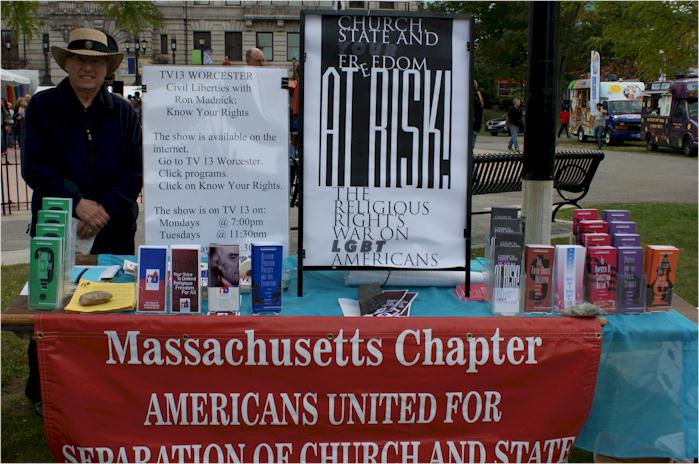
Ron Madnick (President AU-MA) at the AU-MA table during Worcester Pride Celabration set up behind Worcester City Commons.
| "Believing with you that religion is a matter which lies solely between man and his God; that he owes account to none other for his faith or his worship; that the legislative powers of the government reach actions only, and not opinions, I contemplate with sovereign reverence that act of the whole American people which declared that their legislature should `make no law respecting an establishment of religion, or prohibiting the free exercise thereof," thus building a wall of separation between church and State." Thomas Jefferson, Danbury Letter, 1802 |
"The
purpose of separation of church and state is to keep forever from these
shores the ceaseless strife that has soaked the soil of Europe in blood
for centuries."
--
James Madison, letter objecting to the use of government land for churches,
1803
"To compel a man to furnish contributions of money for the propagation of opinions which he disbelieves and abhors, is sinful and tyrannical."
--Thomas Jefferson: Bill for Religious Freedom, 1779. Papers 2:545